Ali Abedi, PhD

About Me
Machine Learning Engineer. Scientist
I build machine-learning platforms that turn data into practical solutions. I am currently creating agentic AI tools for healthcare at Peter Munk Cardiac Centre, Toronto General Hospital, Canada.
8
+
Years of Experience
32
+
Projects Done
37
+
Publications
Skills
What I Do
End to end AI and machine learning platforms spanning software development, advanced modeling, multimodal data analysis across text, images, video, graphs, time series, and tabular data, and cloud deployment with MLOps.
01
Programming & Development
Python, Kotlin, C++, and SQL development across web, backend, Android, and Wear OS applications, with a focus on scalable and maintainable systems.
02
Machine Learning & AI
End-to-end machine learning using PyTorch, Scikit-learn, OpenCV, LangGraph, and AgentKit, covering NLP, large language models, retrieval-augmented generation, computer vision, deep learning, anomaly detection, and statistical modeling.
03
Model Deployment & MLOps
Cloud-based deployment and monitoring on Microsoft Azure and Google Cloud Platform using Git, Docker, Flask, and FastAPI, with CI/CD pipelines and containerized model serving.
04
Data Analysis & System Expertise
Analysis and integration of graph, image, video, text, time-series, multimodal, and tabular data to support robust AI systems and data-driven decision making.
05
Research & Scientific Leadership
Study design, hypothesis-driven modeling, dataset curation, systematic scoping literature reviews, benchmarking and evaluation of machine learning systems, statistical validation, reproducible research, peer-reviewed publishing, grant writing, and research ethics in AI for healthcare.
Resume
Education & Experience
A journey grounded in rigorous training, impactful research, and real-world machine-learning work.
Postdoctoral Researcher
@ Institute for Clinical Evaluative Sciences, University of TorontoPostdoctoral Fellow
@ Intelligent Assistive Technology and Systems Lab, University of TorontoPh.D. in Electrical Engineering & Computer Science
@ Tarbiat Modares UniversityM.Sc. in Electrical Engineering
@ Amirkabir University of TechnologyB.Sc. in Electrical Engineering
@ Amirkabir University of TechnologyMachine Learning Engineer
@ Peter Munk Cardiac Centre, Toronto General HospitalResearch Associate
@ Lawrence Bloomberg Faculty of Nursing, University of TorontoScientific Associate
@ KITE Research Institute, University Health NetworkMachine Learning Engineer
@ Toronto Rehabilitation Institute, University Health NetworkMachine Learning Engineer
@ Quark SoftwarePublications
Publications
A collection of peer-reviewed papers highlighting recent research and collaborations.
- 01
OPEN: A Benchmark Dataset and Baseline for Older Adult Patient Engagement Recognition in Virtual Rehabilitation Learning Environments
arXiv · 2025
- 02
Artificial Intelligence–Driven Virtual Rehabilitation for People Living in the Community: A Scoping Review
NPJ Digital Medicine · 2025
- 03
Rehabilitation Exercise Quality Assessment Through Supervised Contrastive Learning With Hard and Soft Negatives
Medical & Biological Engineering & Computing · 2025
Blog
Latest Blog Posts
Thoughts and insights on machine learning, AI systems, and real world applications in digital health and beyond.
An interactive series on judging models: confusion matrices, precision and recall, ROC and PR curves, agreement between models, calibration, thresholds, imbalance, confidence intervals, t-tests, test set size, leak-free splits and regression metrics.
Posted on October 12, 2026
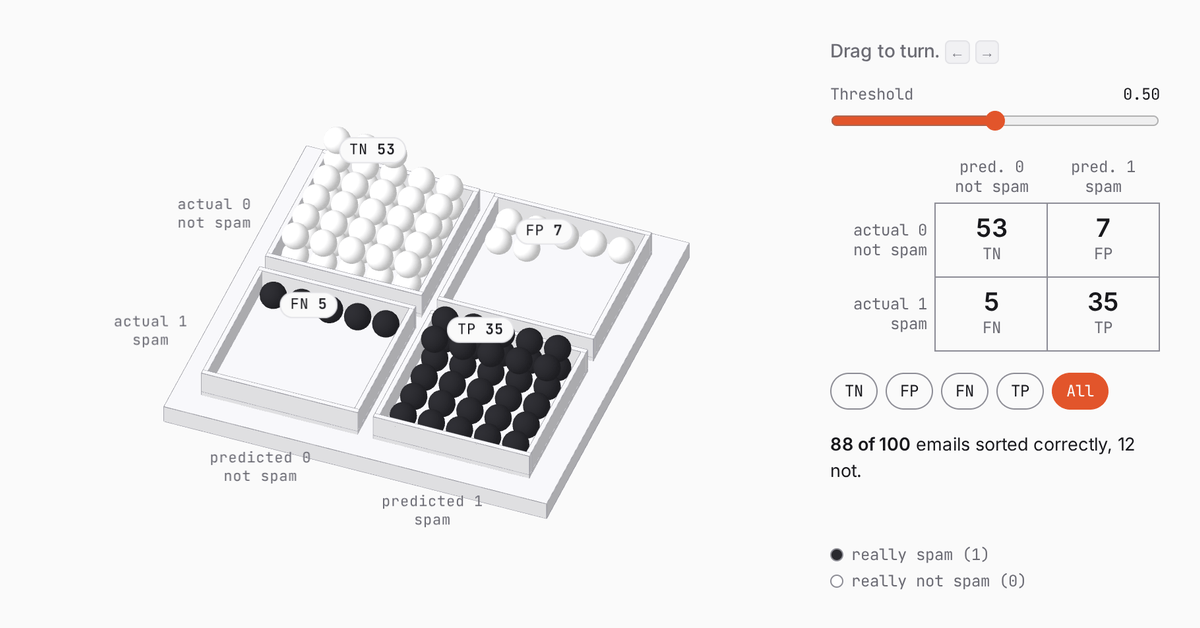
Part 1: Reading a Confusion Matrix
A classifier can be right in two ways and wrong in two ways, and a confusion matrix counts all four. Part 1 of the evaluation metrics series walks through the four bins, the threshold that fills them, and what changes past two classes, with three live 3D figures you can turn and tune.
Read more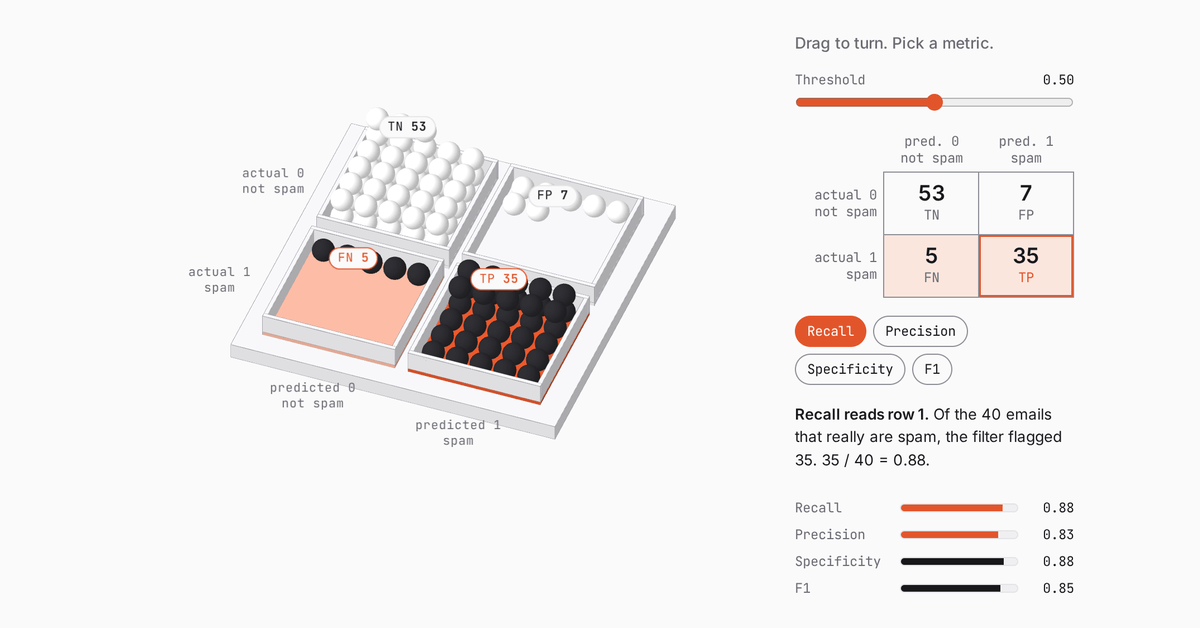
Posted on October 12, 2026
Part 2: Precision, Recall and F1
Recall reads across a row. Precision reads down a column. F1 weighs the two together. Part 2 of the evaluation metrics series reads them off the same 100 emails and the same threshold slider, then extends them to more than two classes with macro and micro averaging.
Read more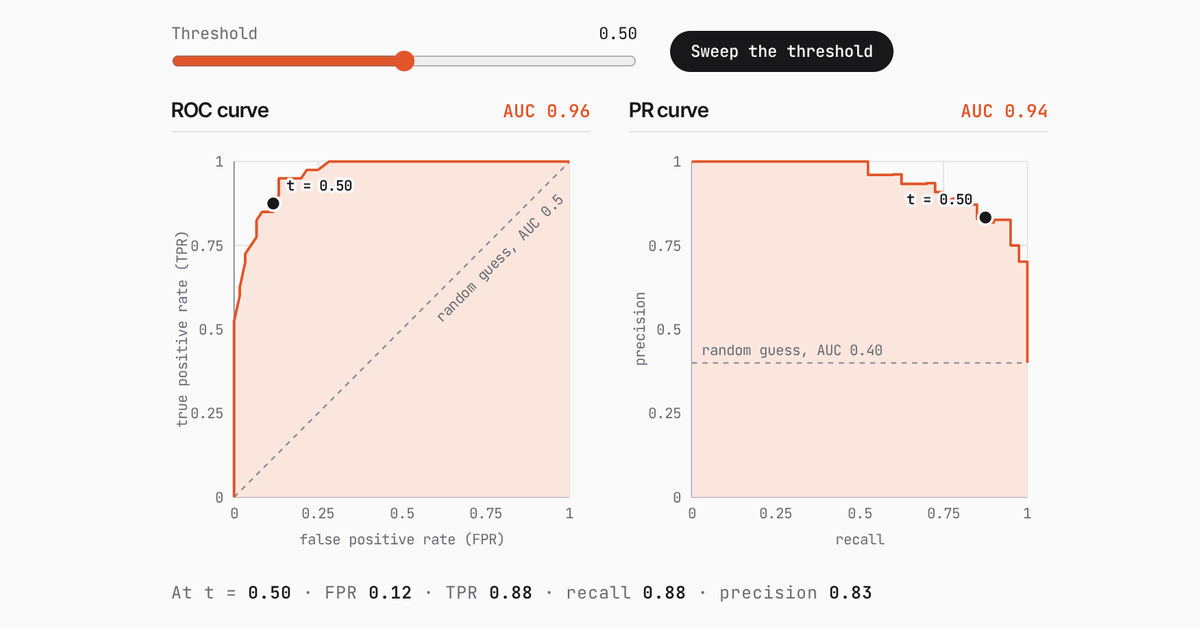
Posted on October 12, 2026
Part 3: ROC AUC and PR AUC
Each threshold gives one confusion matrix. Sweep every threshold and the matrices trace a curve. Part 3 of the evaluation metrics series builds the ROC and precision-recall curves from the same 100 emails, and shows which area to report and when.
Read more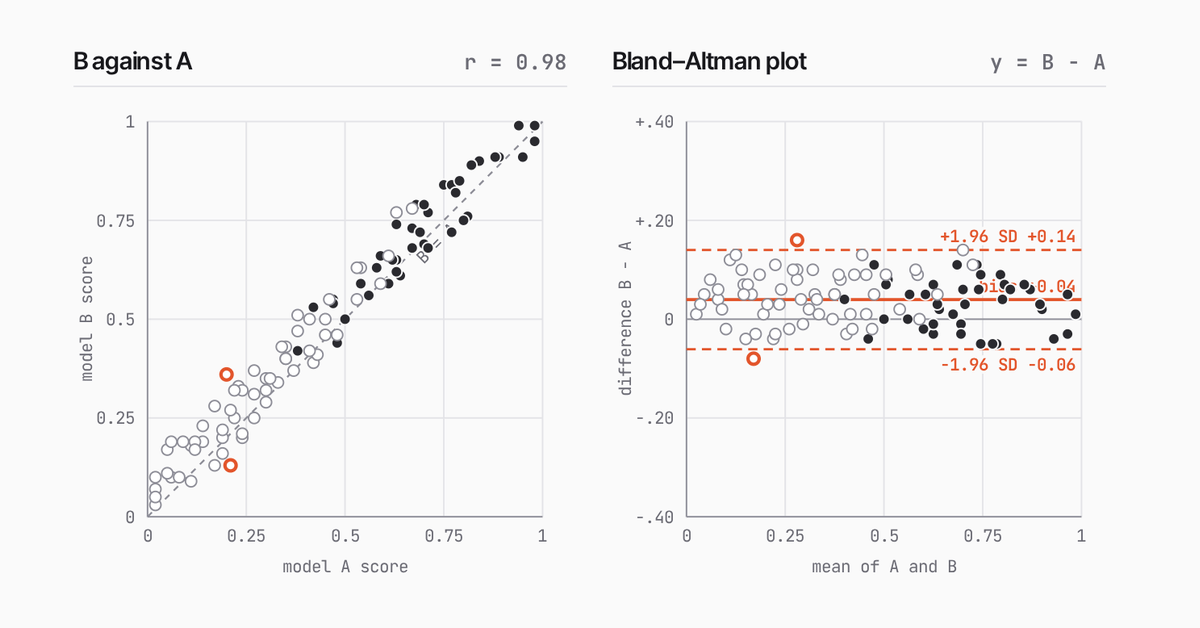
Posted on October 12, 2026
Part 4: Do Two Models Agree? Bland–Altman Analysis
Correlation is not agreement. Part 4 of the evaluation metrics series compares a spam model with a smaller, cheaper one on the same 100 emails, using the bias between them and their limits of agreement to decide whether one can stand in for the other.
Read more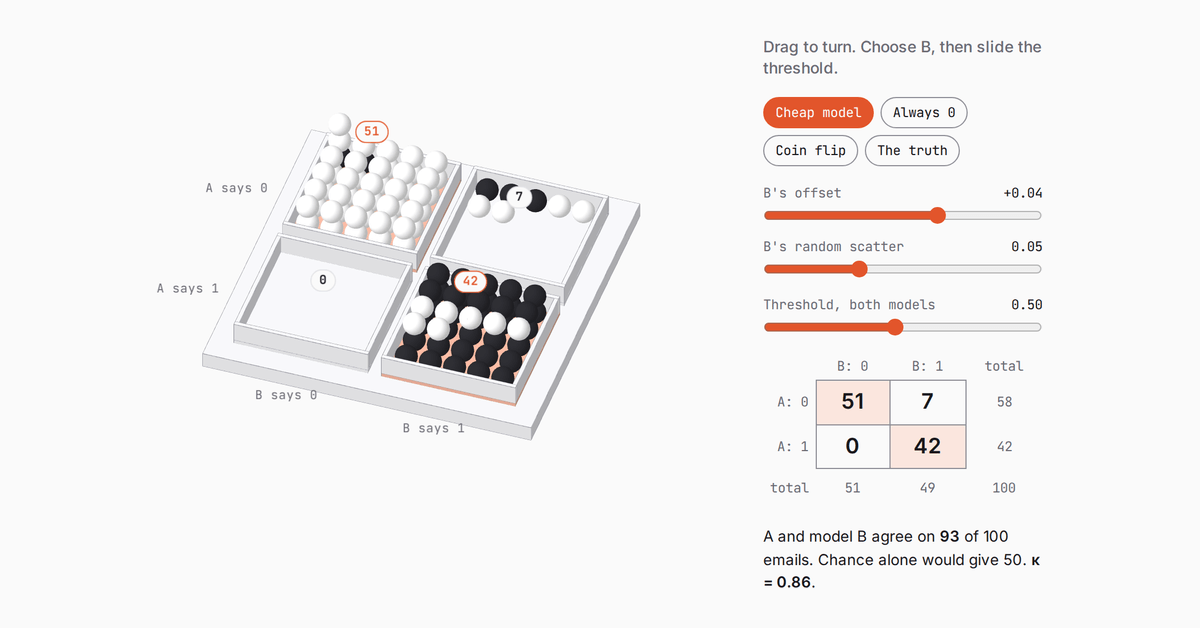
Posted on October 13, 2026
Part 5: Cohen's Kappa
Two models can agree on most emails just by both saying not spam. Part 5 of the evaluation metrics series counts how often the part 1 model and a cheaper model give the same label, subtracts the agreement chance alone would give, and shows the prevalence trap, how to read the number, and kappa for more than two labels.
Read more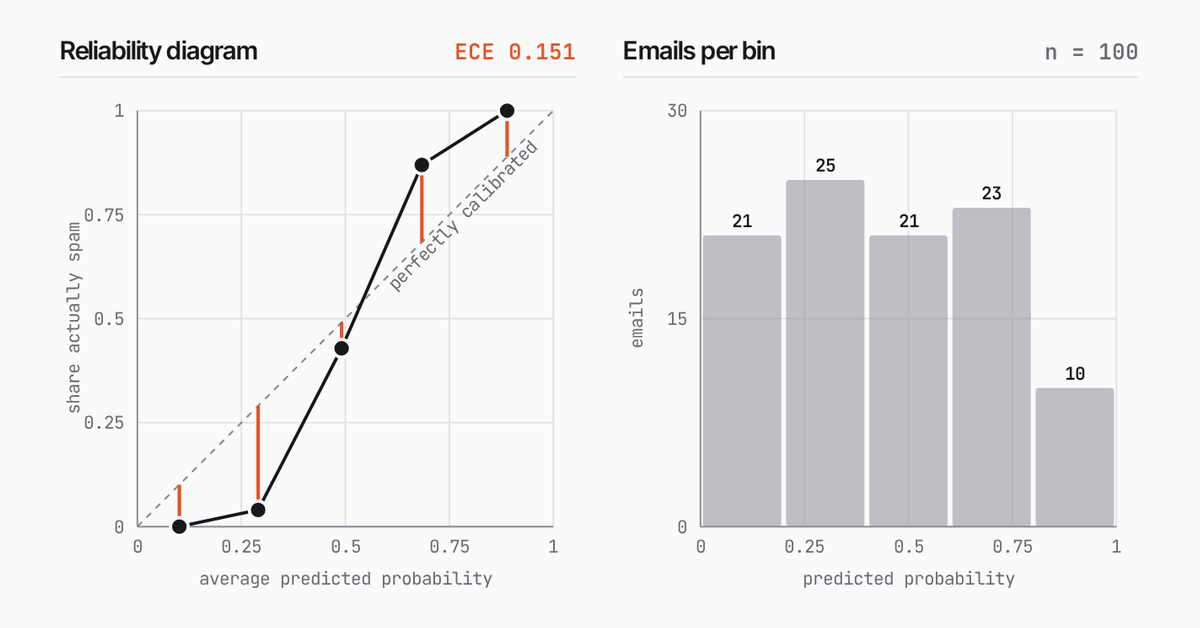
Posted on October 13, 2026
Part 6: Can You Trust a 0.7? Model Calibration
A model is calibrated when its probabilities come true at the rate they claim. Part 6 of the evaluation metrics series draws the reliability diagram for the same 100 emails, scores it with expected calibration error (ECE) and the Brier score, shows why good ranking is not good calibration, and fixes it with Platt scaling.
Read more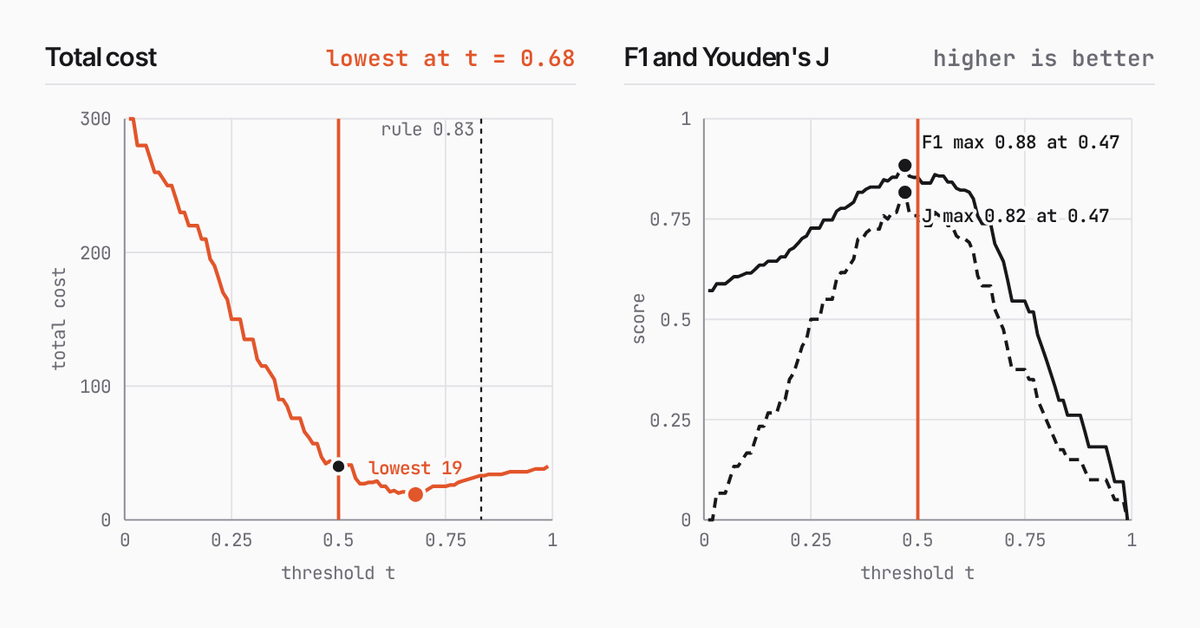
Posted on October 13, 2026
Part 7: Choosing the Threshold
Every threshold trades one mistake for the other. Part 7 of the evaluation metrics series puts a price on false positives and false negatives and finds the threshold that costs least, compares it with the rule for calibrated models, Youden's J and the highest F1, and explains why the threshold is chosen on validation data, not the test set.
Read more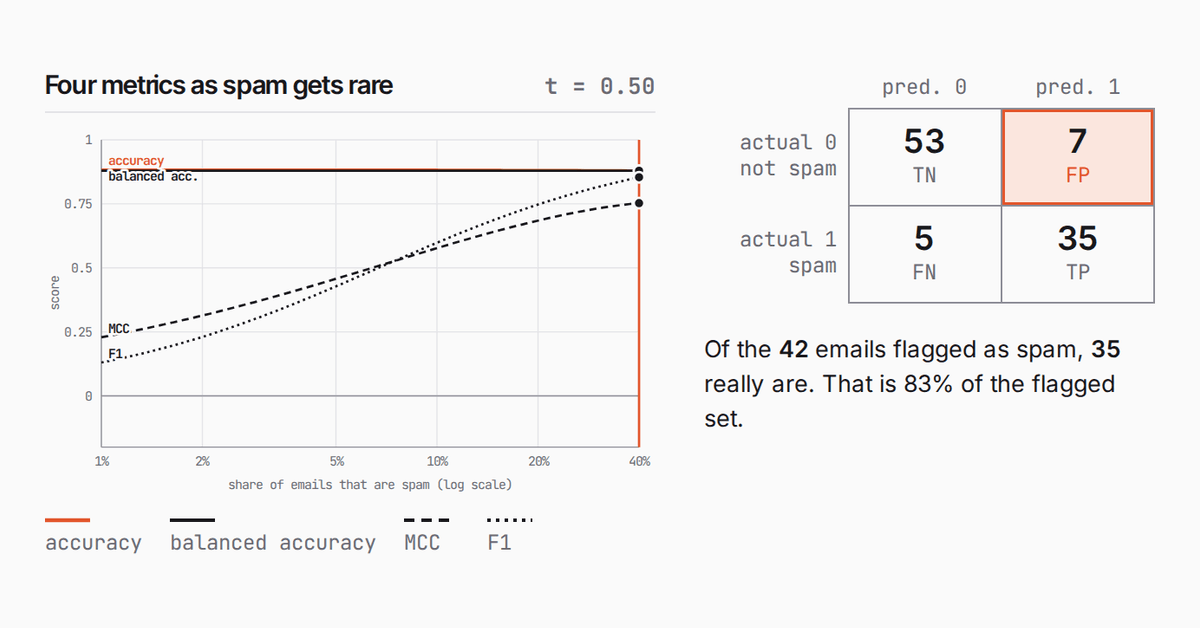
Posted on October 13, 2026
Part 8: Metrics for Imbalance
When spam gets rare, accuracy flatters. Part 8 of the evaluation metrics series makes spam rarer and rarer for the same model and tracks accuracy, balanced accuracy, the Matthews correlation coefficient (MCC) and F1, shows a model that never flags anything scoring 99% accuracy, and explains which question each number answers.
Read more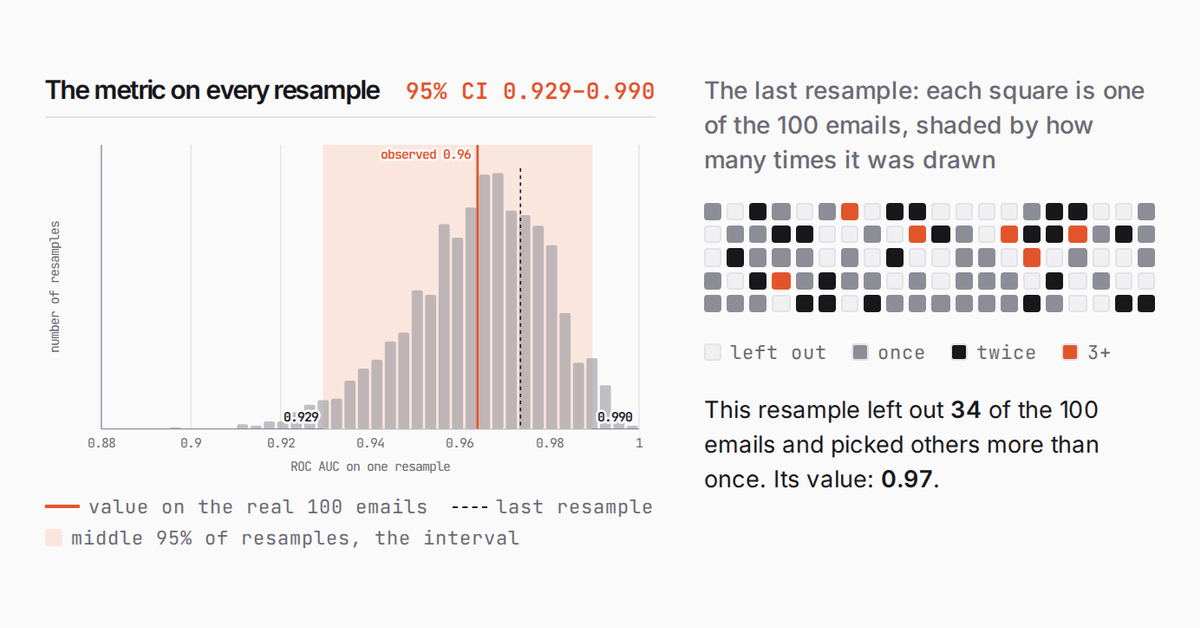
Posted on October 13, 2026
Part 9: Confidence Intervals and the Bootstrap
A confidence interval is a range, computed from your data, that is likely to contain the true value of what you measured. Part 9 of the evaluation metrics series defines it and its building blocks, then computes it for the same 100 emails two ways: by resampling the test set 1,000 times (the bootstrap), and with a formula for accuracy, with a Wilson-interval calculator. It also separates test-set uncertainty from training-seed variation, compares two models with a paired bootstrap, and shows how to report each.
Read more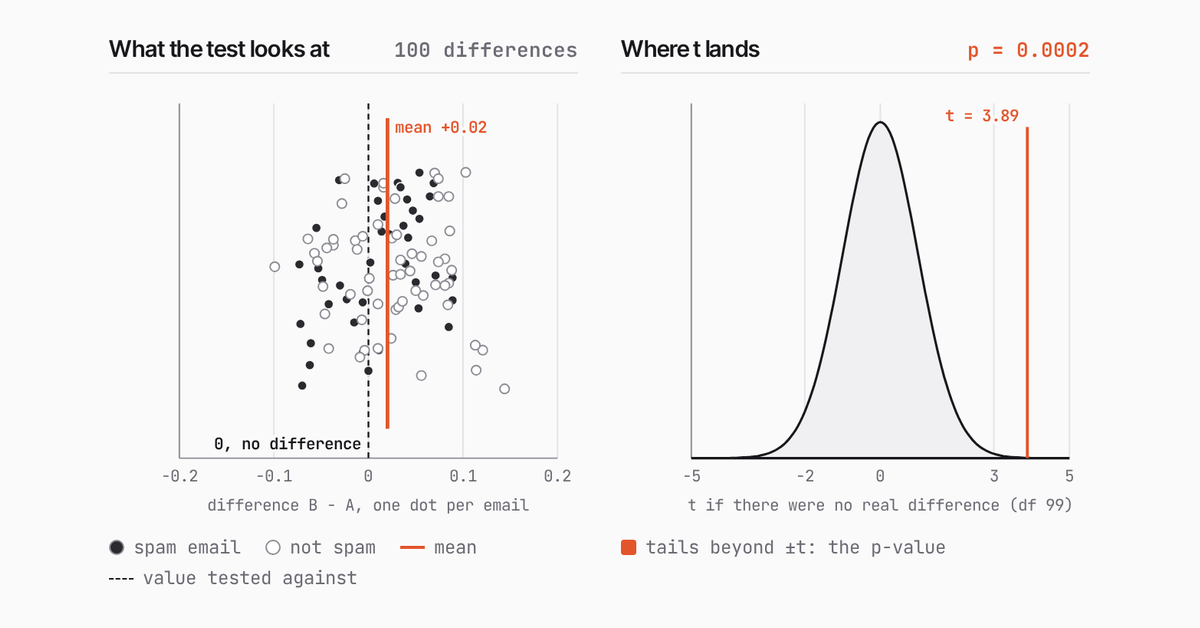
Posted on October 13, 2026
Part 10: The t-Test Family
Three tests, one idea: a difference divided by its noise. Part 10 of the evaluation metrics series runs the one-sample, paired and two-sample (Welch) t-tests on the series' model scores, shows what goes wrong when paired data gets the two-sample test, and covers the assumptions and the rank-based alternatives.
Read more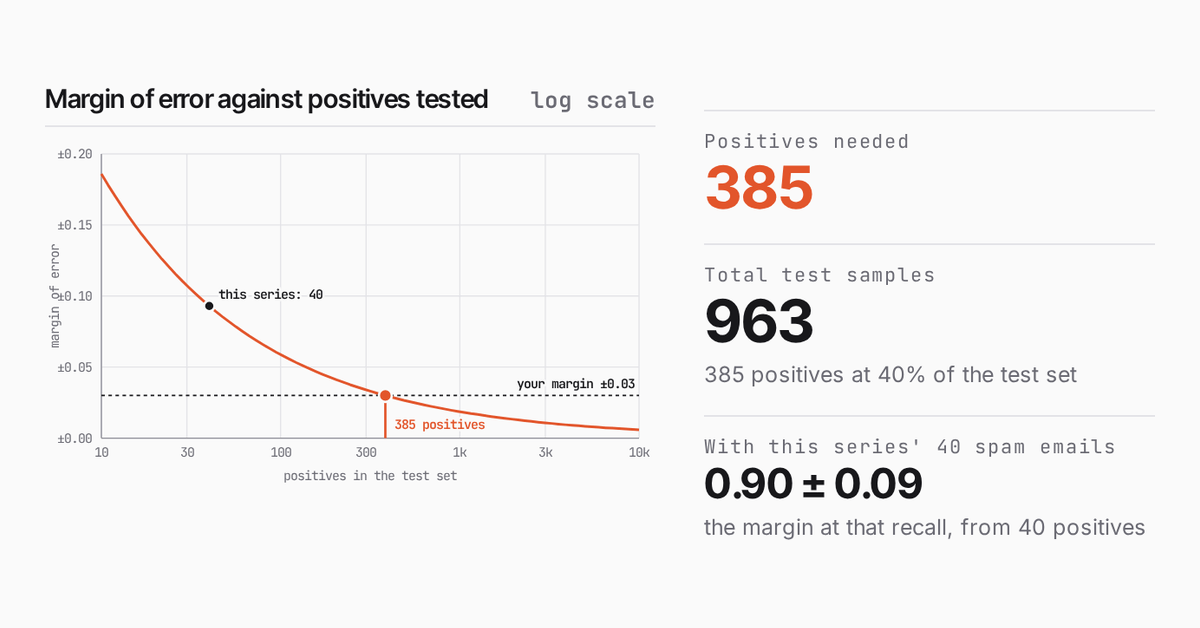
Posted on October 13, 2026
Part 11: How Many Test Samples Is Enough?
Enough that the reported number is precise enough to make the decision, and no fewer. Part 11 of the evaluation metrics series writes the requirement first, then sizes the test set from the margin of error, from statistical power for a pass-or-fail target, and from the rule of three when no failures are expected, and shows why every subgroup needs its own count.
Read more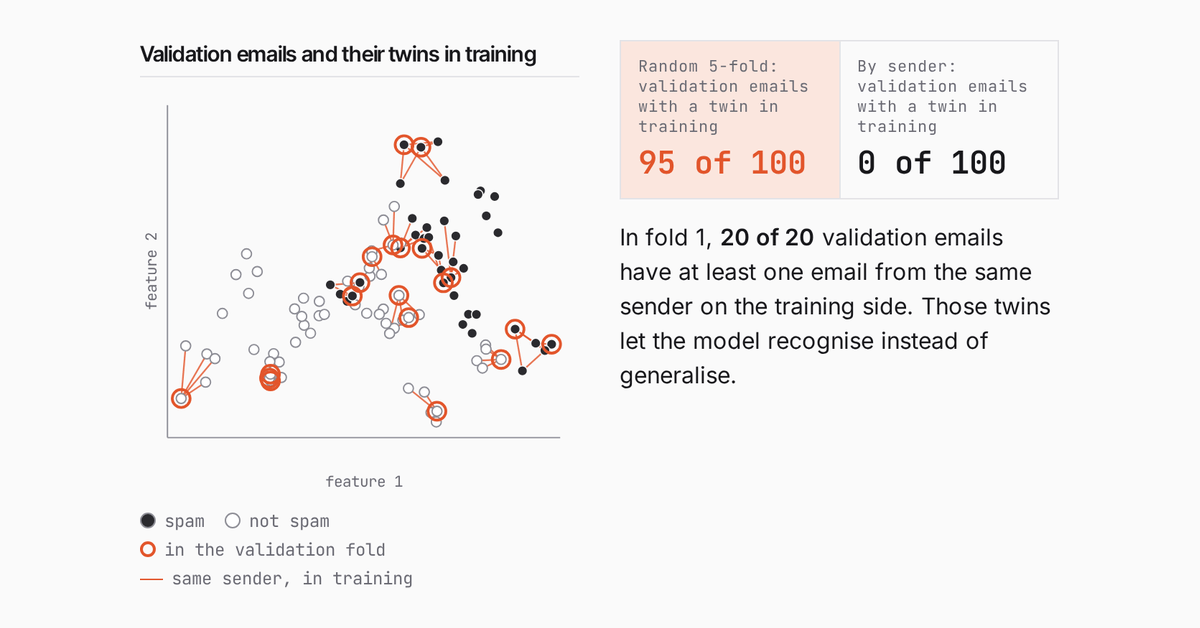
Posted on October 13, 2026
Part 12: Splitting Data Without Leaking
Every number in the series assumes the test emails were never seen while the model was built. Part 12 of the evaluation metrics series gives training, validation and test sets one job each, runs k-fold, leave-one-group-out and nested cross-validation, and shows how near-copies from the same sender leak across a random split.
Read more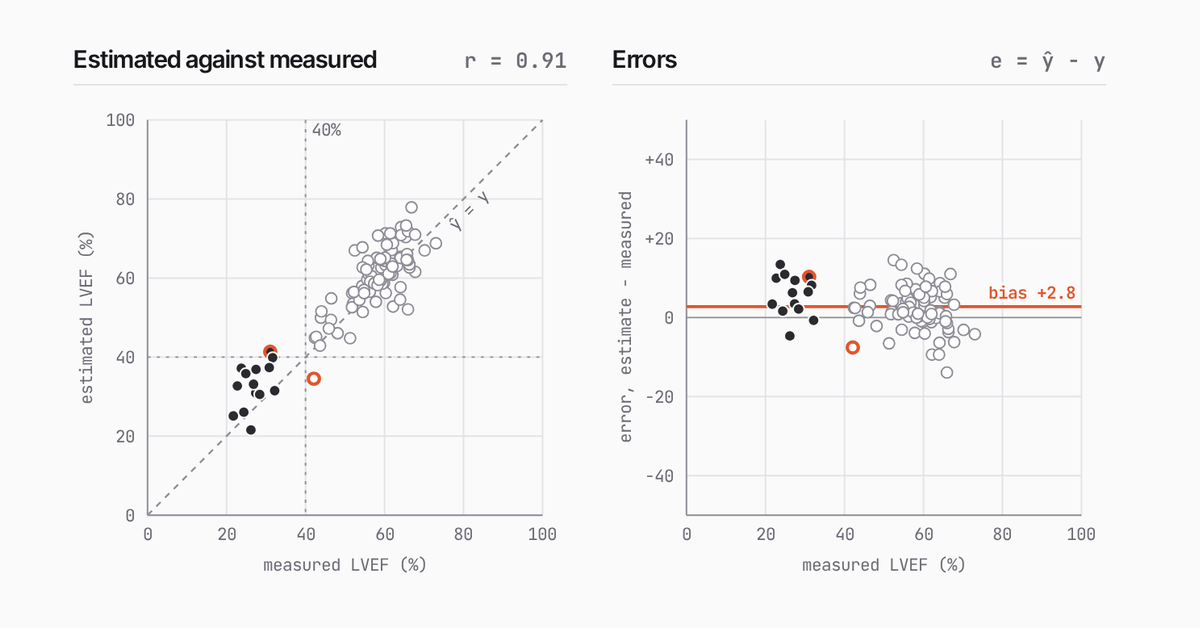
Posted on October 12, 2026
Part 13: Regression Metrics
A regression model predicts a number, so every prediction is off by some amount. Part 13 of the evaluation metrics series scores a model estimating heart ejection fraction for 100 patients with bias, MAE, MSE, RMSE, MAPE, R², explained variance, Pearson and Spearman correlation and Lin's concordance, and shows why correlation is not R².
Read more



Get In Touch
Get In Touch
Interested in my research or development projects? Reach out and I’ll get back to you shortly.
- +1 (416) 597-3422 x7971
- ali.abedi@utoronto.ca
- 585 University Ave, Toronto, ON M5G 2N2, Canada